
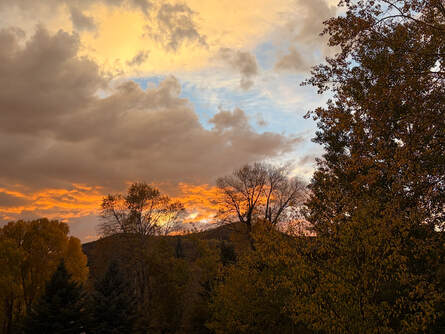
 Autumn in the Sky - October, 2026 Independence, noun: the ability to live your life without being helped or influenced by other people. (Cambridge Dictionary) Tomorrow is Independence Day in the U.S. Flags, parades, hot dogs, hot weather. Summer’s climax. But on this morning’s hike, straps biting into my shoulders with 20 lbs of dumbbells in my daypack, I have another sort of independence on my mind: independently aging. To me that means aging capably, cultivating resilience in both body and mind as the years go by. Surely this starts with mindset. Because, things happen as we age. Unexpected things like a chronic pain or illness, a cardiac event, an injury that takes five times longer to heal than it used to. Things that start to make us reluctant to venture out. Things that make the chair in the summer shade or the soft warm winter couch alluring for too many days or hours. Those cozy spots are siren calls, and we might then find ourselves wrecked on the rocks of stiffness, immobility, enervation and ennui. Sometimes mindset needs a little work. Those mornings when I dread getting out of bed to go run up a hill, I think into the near future, when I’m back from that run. I know I’ll feel energized, clear-headed, and fully alive. I know that the sooner I get out the door, the sooner I’ll be drinking coffee and eating my yummy breakfast. Cultivating this discipline helps my mind stay resilient in the face of discomfort and challenge. Physical challenges are sometimes a matter of the patience to build up to something. Doing fingertip pushups to make my hands stronger for my massage work has been a game-changer. Several years ago, I could have quit and chalked it up to my hands being too old and too tired. I decided instead to get stronger. At first I could just do two or three fingertip pushups. I’m now doing 60 (to be clear, I’m on my knees). Building the strength in my hands and arms means that I continue to do the work I love, and that sense of capability plays out in other areas of my life as well. Independently aging also means having the perspective of the long game. Things might take longer to do than they used to. Healing time might be longer, recovery and rest are more of a priority, new goals need a longer timeline. I so often hear from folks older than me their seeming amazement that they haven’t recovered from this injury or that joint replacement within the tiny window of time they allotted. I wish they’d tune in to what their body requires, work together with their own body as a team, and I think the recovery would be much more successful despite the time necessary. This too speaks to cultivating resilience. Years ago, I had a client named Sylvia. Sylvia was a feisty Italian woman who’d run a grocery in New York City with her husband while they raised their family. Due to an aneurysm decades before, Sylvia had progressive neurological issues. Working out in the warm pool at the retirement campus where I worked was important therapy for her, and she’d get a massage afterward. She’d come down the hall to my office, first with a cane and later in an electric wheelchair, her white hair elegantly styled, make-up and clothing impeccable. This took a painstaking amount of time, but Sylvia would not walk out unless her appearance was just so. She did everything this way. Getting ready took longer and longer as she moved more slowly. She shared how it might take her two hours to get a simple meal together at her home, where she lived alone. There came a day when she hired someone to clean, and then someone to take her to the grocery store. I asked her about that. She said, “I hope that I’m never too stupid to ask for help when I truly need it.” Her words have stayed with me. Sylvia was independently aging. She had the discipline, the mindset, and the courage to live her life on her terms. When challenges came, she figured them out. Even when it meant being smart enough to ask for help when she was ready. Originally published July 3, 2025
0 Comments
 Sun-Warmed Reflections: Hahns Peak and Pearl Lake - June, 2025 I used to think warming up before any athletic endeavor was an optional nicety if time allowed. In my twenties, my boyfriend would stretch his ski legs before hopping in the lift line, and I thought, “how novel!” When I watched other runners warming up at marathon start lines, I thought, “I’m about to run 26.2 miles, surely I will warm up along the way?” When I ran weekly with my store manager (I worked for a sporting goods store in California before moving to Steamboat), we always had to schedule our start around his hot tub time. He told me he couldn’t head out on a run if he didn’t get everything warmed up before-hand. I thought he was a bit of a princess. Now at 58, I know that the warm up is not novel, not optional and I am certainly not a princess. Moving first thing in the morning by way of a brief but thorough warm-up not only prepares me for exercise, but gives my body and brain the foundation for a good day. The variety of movements that get my legs and upper body moving and encourage circulation help not only warm my muscles in preparation for my run, but specific things like ankle circles, body weight squats and upper body figure-8s help my joints (specifically my ankles, knees, hips, shoulders and spine) move more smoothly. The increased breathing and heart rate prepare my heart and lungs for the work to follow, and the increased oxygen to my head dissipates some of the early-AM brain fog. Even if I’m heading out for a walk, or just getting right into my day, the warm-up is valuable. I’d like my body and brain on-line no matter what. That ease into the day or exercise warm-up is key. But I’ve recently experienced a next-level warm-up that kicks my bum. I do a weight work-out at Old Town Hot Springs twice weekly. For the past seven months I’ve sweated my way through lifting heavy (6-8 reps max per set). Results? My glutes are no longer in hiding and I can lift heavier weights than when I started. But my running hasn’t changed an iota. As I’ve written before (Salida Trail Marathon Epilogue: A Run Through Time), despite the lifting, my running is less “moving swiftly” and more concrete legs dragging a heavy load up a steep mountain. It isn’t just strength I need - and strength is defined as the ability to exert force against resistance. I need power too. Power is defined as the ability to exert force quickly, as in explosiveness. My daughter, running circles around my straight line shuffle, has power. I do not. That’s why it feels like I’m dragging an anchor the size of the Queen Mary around. I can drag it (strength) but not quickly (power). To that end, I decided to take a class right after my lifting session. PowerFit - the perfect choice. I showed up for my first class, and we started with the “warm-up.” Skipping (forward, backward), high knees, kick bum, side-steps, twisting lunges, etc., etc. By the time we were done I was ready to lie down on the floor for the rest of class. Unfortunately, the instructor wanted us to do more than just warm-up and nap. We did rounds of hamstring curls, lunges, single-arm rows, and a few other things my brain prefers to forget. Then we did broad jumps. I had to check my shoes - why were they stuck to the floor? It seemed I could not actually get my body off the ground. This girl had no hops. The instructor discreetly suggested I do another round of high knees instead. Then, after class, he kindly suggested a dynamic warm-up I could do on my own, incorporating several of the exercises we did in class. If I did this dynamic warm-up consistently, it should help. Several weeks later, this warm-up is still challenging, but I can see incremental improvement. And, last week, I was able to do the broad jumps! The warm-up has become not just a way to prepare, but a way to improve. According to the instructor, power is one of the first things to go as we age. I wasn’t doing wrong by focusing on strength training, but I needed to add in training for power as well. Dynamic, quick bursts of movement such as what I get with that challenging warm-up will help balance the strength gains with more explosiveness. Although I’m still a ways out from being explosive. My goal is to be both stronger and more powerful. Will this get me up the hill any faster? Not tomorrow. Not next month. I’m probably looking at a year from now. That might seem like a long time to see results. But think about it. I haven’t been working that dynamic power system consistently for decades. And, especially in the last decade, that system hasn’t just been waiting for me to pick back up and be right where I was in my twenties. That system has been declining. So training for power will begin to stop that decline, and even make some modest gains. Of course I will still have dreams of being able to keep my daughter in sight on a run, though the truth is I may never do that again. More important than realizing that dream is that I can still improve. I can get stronger, and maybe a little quicker. And that improvement, even just the possibility of it, is worth warming up for.  Evening Silhouettes - February, 2026 Imagine that you are preparing for bed. You’re in your softest PJs, you’ve brushed your teeth and washed your face, and your water glass is on the bedside table. There is only one lamp giving out a warm light. You spritz your pillow with a light mist of lavender, chamomile, rose or jasmine to promote sleep. Using a massage tool, a tennis ball, or a small foam roller, you knead the tension in your shoulders and neck, breathing in easily as the tight muscles let go. Your head hits the pillow and you sleep like a baby until morning. A bedtime routine, aromatherapy, and massage can all contribute significantly to quality shuteye. As a massage therapist, clients have shared that they sleep better after having a massage - even with an afternoon appointment, the effects carry through to good sleep that night. Massage can release those helpful feel-good hormones like serotonin, oxytocin and dopamine, while decreasing cortisol. And massage eases pain, decreases stress and reduces anxiety, all of which can lead to improved sleep. I’ve also encouraged clients to pay attention to the sensations they feel during a massage - the feel of the sheets, the smell of the aromatherapy, the sound of the music - so that they can remember those sensations at bedtime to again feel the relaxation of their body and mind. This is a great way to extend the benefits of massage. The research I’ve seen is mostly subjective when measuring for relaxation and sleep quality, although some objective data can be gathered, such as salivary cortisol to determine stress before and after intervention. But a massage’s easefulness is subjective. And in my experience, not all massage sessions are created equal. I used to get bodywork from a therapist whose touch and vibe were so calming and safe that I fell into a zone - not quite sleep but not exactly in the here and now. These sessions left me deeply relaxed - so good for my head and body. Recently I had a somewhat different experience. As soon as I walked in the door it seemed as if we had a schedule to adhere to and we were falling behind. The session was a cookie cutter routine, and the therapist’s forearm on my upper back felt like a Ford F-350 ripping across the speedbumps in a parking lot at full speed. It wasn’t until after the session, when I walked out of the building and sat in my car, soaking in the sunshiney warmth, that I actually relaxed. I had just paid a lot of money to be tense, stressed, and feel like an asphalt parking lot. What would that massage have been like if the therapist had really felt the tissue under her hands, and worked with the tight areas in my body to bring some movement, ease, and blood flow? This makes me think of the how-to-give-a-massage-during-Covid video. The various methods for delivery like “tribute hands,” “swiffer aromatherapy” and “light saber reflexology” are spot-on and hilarious. Why did my less than relaxing recent massage experience make me think of this video? Because there was no real connection between therapist and client - everything was scripted and generalized. To be fair, this is the level at which some people prefer to receive massage - kind of like small talk at a party. You end up not learning much and with a vague sense of dissatisfaction. But there are ways to have even light conversation where you still learn what the person’s work is, what interested them in that work, and how they like it. You might learn something new about that field of work, you might feel you understand this new person a little bit, the conversation might even shed some light on your own work. Connection below the superficial surface. With massage, you can have that same kind of connection. Mostly it is the awareness (of both therapist and client) of what’s moving, what’s not moving as well, and soreness or even pain. But it isn’t only muscle and connective tissue and fascia on the massage table. There is the understanding of parts of the client’s life - are they out for hours running or cycling, have they been in front of the computer for a stressful season of work, or looking after an ailing family member? There is so much more than the surface muscle tension to be addressed and acknowledged. Clients sometimes rib me for being a little generous with the massage time. And I think a part of this is allowing for connection. A listening to the body and its rhythm. Some tightnesses can’t be rushed along. They require patience and kindness - and perhaps persistence. If there were more of this space for considered connection, in conversation, in massage - in day to day interactions, perhaps we would all be learning a bit more, be more attuned to one another, and certainly much more relaxed. And maybe we’d all be sleeping better too. Source AMTA: Massage Therapy’s Effect On Sleep  Ridge Trail, looking south - Emerald Mountain, August, 2025 (Read Salida Trail Marathon Part I: One Step At A Time and Salida Trail Marathon Part II: The Best Day ) I look at the rush of water that is Fish Creek, in such a hurry to get to the Yampa River and then the Colorado. I just want to say to it, slow down and stay awhile. You won’t make it to the Sea of Cortez anyway, you’ll just peter out in the Sonoran Desert. I wish I could hold the flow here longer. Despite the un-winter with little snow and plenty of unseasonably warm temps, the spring melt still manages to make a low roar, filling my head, and I smile. It is a treat to trot alongside this waterway as it splashes up against and pours over the many rocks along the way. Happy to be running on a trail, I climb the half-mile of switchbacks and head back down, then turn around and do it again. It is quiet, there’s no one around this morning, for which I am grateful. I can enjoy the peace and don’t have the worry that I’ll encounter someone who will silently agree with me that I’m moving very slowly. Not that, in reality, they’d even notice. But I notice. I think back to my Run Through Time finish just a few weeks ago, on March 14th, the completion of my first trail marathon, and it isn’t exactly pride that I feel. When I think of my daughter running it - and running it well - I feel a swelling in my chest that is pride and love and even joy. But my own run? That feels…complicated. There’s the finish time difference - Charlotte’s 4:35 to my 7:06. And there’s the age difference - her 19 to my 58. But the numbers don’t tell the whole story. It took everything I had to get through that day. Mentally and physically I started with what felt like nothing, and yet somehow ran up and down hills for 26 miles. While on the four-mile trudge up bleak road, I was so sure I wouldn’t make the time cut-off at the top it seemed pointless to continue. Yet somehow I kept pushing myself to keep going, striving for what speed I could muster, the stress of not being fast enough driving me forward. When I made the time cut-off, relief or elation weren’t on the table, because I still felt the pressure to make the second cut-off. In the last few miles the warmth and fatigue were really taking hold, and yet somehow my brain and body maintained - and summoned a sprint (for me) to the finish. It did feel terrific to be done and to be with my daughter and friend. Re-reading this paragraph, I feel gratitude and a bit of awe for how my body and mind performed on that day. But that’s still not the whole story. I also have questions. Why was I so low energy, why was there so little in my muscles that I was doing the death-shuffle right off the start line? Why did my legs feel like concrete the entire day? Why, with all the hill climbing and heavy lifting I did in my training, did that not play out in increased power - even slightly? Why did I used to be capable of decent running speed but now my 30-second sprint pace is the pace I used to run an entire road marathon in? Last summer when I was toiling up the Colorado Trail for the fourth day in a row alongside Charlotte, who was not toiling, I said “I can do anything if it is just for one day.” This was the phrase that resulted in us signing up for the Salida trail marathon. I believed that with dedicated training - running and lifting - I’d improve my speed and power. But speed and power have not shown up. I’m not talking about huge improvements in my paces so much as the sensation of speed and power. A sensation I took for granted until it disappeared a year or two ago. It is so easy (and disheartening) to look back over the decades of rowing, running, triathlon-ing, backpacking and cycling and remember how fit and capable I felt doing those things. When I trained, I got stronger. A logical equation with mental and physical results. But right now, that equation is broken. I train, but sometimes the results are diminishing returns - low energy, weakness, mental exhaustion. This is not easy to accept. The official name of the race is the Run Through Time Trail Marathon. The name refers to the course which travels through old mining territory. I love the name of the race - in fact it is one of the reasons we signed up for the Salida trail half-marathon last year. Now that name resonates in a more profound way: a run through times past. Times past - 58 years of experiences crammed into the nooks and crannies of my mind. Because these times are past - long gone. There is a sense of loss, and of longing. For older family members, my daughter’s childhood, for the days when you didn’t have to wait in a lift line on a powder day. The loss of how I thought my life would look from the perspective of my twenties and thirties. The loss of a myriad of moments: sitting on the floor between shelves reading a mystery book in the single-room library (the Graham Annex) I rode my bike to; backyard crab feasts thick with Baltimore accents in the humid air, game contests, beers in hand, piles of steamed crabs and wooden mallets and so much laughter; my young and tough Charlotte, running up the hill after me in her pink Boggs snow boots, determined to go where I went. But isn’t that simply life? We all have the losses, the longings, for the experiences that fill up our senses and brains until there’s hardly room to squeeze in one more. This really is the stuff of life, and it’s so good, but it can also be so heavy when the loss outweighs the freshness of new experience. Running through time, just as running through historic mining areas, is about perspective. We see the times past from here because we are no longer there - but dang isn’t it awesome that we had those times at all? The thing is, and maybe this is the key thing: I’m still running. It might not look like I think it should look. And some days it definitely does not feel like I’d like it to feel. But I am running. It is a powerful connection I share with my daughter. Sometimes I even get to run with Charlotte and we talk. Well, she talks, I pant. There are days on the trail where I feel incredibly, gloriously alive, surrounded by all that sumptuous nature. I am very very lucky. So, complicated feelings about my Run Through Time experience and all, what is next? I think next is about looking forward. About my new starting line being from age 58. About where I can go from here. The possibilities ahead rather than pining for the past that is behind. About running with the wind in my hair, and not worrying about time at all.  "Get Busy Livin' "- Top of Beall Trail, Emerald Mtn, October, 2025  View from the course - looking south to the Sangre de Cristo range Run Through Time Trail Marathon - March 14, 2026 (Read Salida Trail Marathon Part I: One Step At A Time) One foot in front of the other and I’m just about to the top of this four-mile uphill bit of Type II fun. I see some folks standing in front of the 12.5 mile aid station - they direct me to continue on up the hill for another half-mile before returning to the station where I get off the road and onto some rolling double track. These volunteers do not pull me off the course - somehow, I have made the first time cut-off! But there’s no time for celebration. I’m not off the hook yet for the second cut-off. The promised wind has picked up, and despite passing another runner or two, the next portion feels desolate. The climbing is more varied but we’re still gaining elevation. Some stronger gusts take me by surprise, and I barely save my hat more than once. I’m in automatic mode, staring down at the dirt, when I come around a turn and a large meadow opens in front of me, with a stellar view of the snow-capped Sangre de Cristo mountains. For the first time today, I relax a smidge. I remember that I love being out on the trails, running through trees and meadows, reveling in vistas to the far-off horizon. I soak that in, and then it’s on to technical, rocky terrain that doesn’t allow for viewing anything but what’s right in front of me. All along I’ve been diligent about eating and drinking. My hydration vest is bulging with a plain water bladder, two soft flasks with a strong electrolyte mix, and tons of bars and chews. It was bulging so much, in fact, that I had to switch jackets this morning because the first one wouldn’t fit over all my fuel. Every few minutes I take a bite of a bar, eat a couple of chews, wash it down with plain water, take a few sips of electrolyte, wash that down with plain water. It is not easy to continue taking all that in, but my body responds well to this method so I keep doing what works. As I approach mile 19.5, the aid station and second cut-off, I’ve picked off another runner or two and realize that I can let go of the time cut-off worry. I do some fuzzy estimates and conclude that Charlotte has finished by now - still hoping that all is well with her, but figuring I would have heard something if there was a problem. Plus I think the warm temps, wind, climbing and technical demand have taken the edge off my anxiety. I grab some water at the aid station and keep on truckin’. For the next few miles, I move along at a consistent pace. I’ve been trading passes with a couple of young women in their early twenties - I pass them, they pass me, and so on. At around mile 23 as I pass them again, I can see that the heat has gotten to one of them. I also know that this is where my old lady endurance kicks in. Being young, they don’t have that edge, so I’m pretty sure they won’t pass me back again. (They don’t.) The last push is a climb up Spiral Drive, where you pass by the “S” lights on Tenderfoot Mountain which overlooks Salida. I am mentally prepared for this, and though it is tough at the end of a long day, it feels kinda good, especially knowing how close I am to finishing. Coming down from Spiral Drive into the last aid station I am feeling decent. I grab some more water and take off, when the volunteers start yelling at me - I’m going in the wrong direction. Oops. I see them watching me so I pull myself together and try to look like I know what I’m doing. Not sure they are convinced. I know from doing the half-marathon last year that the last mile of this race is a heartbreaker. You can hear the cheering from the finish at Riverside Park across the river as you switchback your way down the front side of the S Mountain. You get to the bottom and think it is just a hop over the railroad tracks, a skip over the river bridge, and a jump across the timing mat to finish. Nope. You get to the bottom and there’s a white arrow (created from flour) pointing you east. At the next possible turn, there’s another arrow - straight.. You keep heading east and just when you think you will never ever see the finish, there’s a right turn!! White arrows, pink flags, and to the finish you go. I run (am I actually running at this point?) across the bridge and a young girl sitting high on a huge boulder at the entrance to Riverside Park cheers me on. “Thank you!” I say, and she cheers louder, energized by acknowledgement. I try to pick up my legs for a finish push but the Frankenstein effect has set it. Then I see and hear Charlotte and Lynn! I am so happy to see them! They are simultaneously cheering and running with me to the finish. Lynn says to Charlotte, “well, she’s running better than us!” I guess Frankenstein can move when the end is in sight. I cross the line with a time of 7:06. I finished! Maybe not my goal time, but I completed my first trail marathon even though I started the day with concrete legs. It turns out that Charlotte not only held up just fine, but performed well - she placed 1st in her age group and 7th woman overall! I’m so proud of her, and very happy for her. As much as I love running, I don’t think that even at her age my body would have consistently performed the way hers does. It feels both surreal and satisfying to hang out in the park post-race with Charlotte and Lynn, cheering the final finishers in. White puffy clouds move across the azure sky. The sun on my skin gives just the right amount of warmth, and the wind is more gentle now as it blows through the leafless branches of the huge old trees. The Arkansas river flows just a few yards away, and the three of us chat away. There is nowhere else I’d rather be.  Charlotte and I at the finish. (Photo credit: Lynn Oslick)  At the start - Salida Run Through Time Trail Marathon, March 14, 2026 (Photo credit: Lynn Oslick) Charlotte and I move through the Salida streets at a quick walk, making our way to Riverside Park. Today is the Salida Run Through Time Trail Marathon (26.2 miles, 3800 feet of elevation gain), which we set our sights on last July. We are both nervous. Charlotte is experiencing a couple of nagging spots since running RUFA two weeks prior, and she’s worried about her body holding up for this race. Understandable. At RUFA, she ran 48 miles and climbed 18,000 feet. On our drive to Salida I asked her if she remembered how difficult of a day it was when we climbed Mt. Yale a couple years ago. We climbed/descended 4500 feet - so her RUFA run was like climbing Mt. Yale four times in one day!!! I’m dividing my stress between worry for her, and worry for me that I won’t make the time cutoffs today. There are two of them - at miles 12.5 and 19.5, and I am not feeling confident. If I don’t make either cutoff, I’ll be pulled and driven back to the finish area at Riverside Park. The actual start is across the river from the park. The runners gather and we make small talk in dim light before the 8:00 start time. The sun isn’t up over the mountain yet, so we shiver with our dear friend Lynn who has driven here from the Colorado Springs area to cheer us on. Though it is chilly now, the day is supposed to get into the 60’s with significant wind, especially at the top of the course. Lynn moves off to the side and everyone joins in the countdown: “Five, four, three, two, one, GO!” All 250 runners competing in the trail marathon move forward as one, our index fingers poised above our watches/GPS devices, punching the start button as we cross the timing mat. And we’re off! Charlotte, sweet girl, wants to run the first bit with me, but a few yards down the flat road and my heartrate is in the red. The anxiety is taking its toll. We wish each other good luck and “I love you!” and she is out of sight in roughly six seconds. A high-end sports car for sure. I slog on, my legs full of concrete, and realize that my get up and go has gotten up and went. The first couple miles are a loop on a fairly flat road with a relatively small climb and I’m trying to get my heartrate back into this stratosphere. When I shuffle back by the start before heading up onto the mountain trail, Lynn cheers me on - but she looks concerned. The next few miles are for me a stress soup of pushing myself to run fast enough to make the first cutoff, finding the neon pink flags and ribbons to be sure I don’t go the wrong way, trying not to fall on the rocky terrain, and worrying about Charlotte. I keep sending messages to her body to hold up for this race. I’m just about in last place, but the bonus of that is peace and quiet on the trail. That way I can be alone with the screaming thoughts looping through my brain: “Hurry up! Watch it, you almost went down there! Oh, I sure hope Charlotte is okay.” I come into the aid station at mile 8 to the blaring of the Rocky theme song and much cheering. The happiness quickly evaporates as I start the next leg: a four plus mile climb up a dirt road baking in the sun. I’m about a mile up and check my pace - at this rate, better to walk and save some energy. I also begin to come to terms that I’m probably not going to make the cut off, but decide to do two things: 1) try as hard as I can to make it; and 2) no crying if I don’t. Having squared that with myself, I put my head down and walk-shuffle my way up the climb. The sandy dirt road keeps climbing, and there are just a few spots where it is less steep so I get in a few running paces. The air is dry and warm, and there is no distraction of a gorgeous view, just scrubby, scraggly high desert flora. These four miles will never end. Then I remember the great Pam Reed, who twice was the overall winner of Badwater, a 135 ultra marathon from the inferno of Death Valley to the chilly elevation of the Mt. Whitney Portal. She wrote that she never sets out to run 135 miles, or 75 miles, or even 10 miles. It is only ever one mile at a time. So, one step at a time, I make my way to the top.  View of Ogden, UT from Malan's Peak - Photo Credit: Charlotte Teuscher  Warming Tent Toast Warming Tent Toast (See Running Up For Air Part I: Stars Shining Over Malan’s Peak here) According to the race tracker, Charlotte and Charlie are in 1st and 2nd place at the summit for their first lap! Charlotte is planning to run five laps - at this rate we might be getting some sleep before the night is done! We whoop as they sprint into the trailhead area. Shannon and Amelia have a lineup of clever signs, different ones for each lap, and they make Charlie and Charlotte giggle. Our intrepid runners are feeling good. They pull up to a table and rifle through the food bags as volunteers refill their bottles and we catch up on the details. The microspikes are key for the icy part, and Charlotte was having heart pains when they started up the steep incline, but she is fine now. (?!) They had a blast chatting away through their six miles and meeting other runners. The two of them have decided to do eight laps. I worry about sleep (for her and for me), and I worry about her body handling that mileage. But I remind myself that this is her race. I am here to support her in whatever way I can. So I pull my worries to the back of my mind. The two C’s take off for their second lap, and we supporters find our own rhythm for the night. Take video and cheer loudly when they come in from their lap. Snap a pic of them holding up fingers for which lap they’ve just done. Tend to what needs tending (nourishment, refill bottles, clothing changes, blisters, tape) while they warm up near the heat lamps. Take video and cheer loudly as they leave for their next lap. I get in plenty of my own laps walking back and forth to where I’m staying. There’s no sleep because I’m checking the tracker. I try to get work done, make hot tea, and when I see that they’ve summited, it is back to the trailhead to await their arrival. I am learning that if Charlotte needs something between laps, she’s more likely to accept help from someone that is not me. As much as she appreciates me being there, I’m still her mom. I’m so eager to help that it isn’t easy to back off, but I do my best to background myself a bit in the support duties. At 11pm, awaiting the end of their third lap, I stand at the trailhead, no one else near for the moment, and stare up. The inky indigo sky is dotted with cloud puffs moving across the gibbous moon. The quiet and lovely night is made more so by the feeling of everyone else at home, asleep, while we - this small band of runners and supporters - are vibrantly alive under the bright moonlight and velvety sky. I am happy to be here, awake. It is now close to 5am and we’re waiting for Charlotte and Charlie to come in from their 5th lap. The breaks have gotten longer, the laps a bit slower, though they are still maintaining an impressive and consistent pace. Headlamps wink in and out through the darkness along the trail up the mountain; we’ve learned to look for the two headlamps together, as have the folks at the timing tent. They know these two and their numbers: “Here come 2403 and 2404!” C and C arrive, and they are tired. Time for a little sleep. Planning to reconvene about 7am, we head to our accommodations and get about an hour of sleep. After a snack and some hot tea we are back at the trailhead. I’m amazed that Charlotte is bright-eyed and bushy-tailed, and the morning sunshine brings a new perspective: “We’ll actually be able to see the trail now!” The two warriors head off for their sixth lap, we three on the support crew clamoring excitedly. We definitely know how to do this support thing! For lap seven, both runners have taped knees in the hopes of easing some soreness that has cropped up - understandable, since with six laps under their belt they’ve completed 36 miles and over 13,000 feet of climbing and descending. Ouch! Shannon yells “run faster this time!” Apparently this advice backfires, as it is their slowest lap. When they arrive, they are at a walk and Shannon’s sign reads “You okay?” It seems Charlie’s body has decided that he is done. After some discussion, Charlotte asks him how he’d feel about her doing the eighth lap on her own. She doesn’t want to make his not doing the eighth more difficult. But Charlie is the real deal. He is behind Charlotte 100%: “you’re the sickest person I know.” (“Sick” = “amazing” in Gen-Z speak.) He gives her a hug to send her on her way, a hug that speaks volumes about the people they are and the friendship they share. And Charlotte is off. Her summit time is the fastest since their first lap. When she comes down the final section into the start/finish area she is flying. And she’s done! The race director, Tara, walks over and hands her a donut. Charlotte sinks her teeth into that sweetness, a big grin on her face. 48 miles, 18,000 feet of climbing. The donut definitely made it all worthwhile. ***** Being a part of this event was humbling. I watched runners accomplish incredible feats of mileage and climbing with no drama and much fortitude.I watched their camaraderie, through the night and all the next day, and I saw respect, and humor, and empathy. I watched volunteers stay up all night supporting the runners; some of those volunteers worked through the night and then raced in the morning - the 12 hour, 6 hour or 3 hour events. I watched kids and dogs frolicking, and everyone cheering on folks they didn’t know - rooting for them to run that next lap, welcoming them back on the return. I watched my daughter run her first ultra marathon adventure with her dear friend, overcoming the times of physical fatigue and mental challenge, and keep on going. I watched her smile, her determination, her confidence in what she can do. This Running Up For Air event (RUFA: Malan’s Peak) raised $15K for air quality solutions. It brought people together in the best ways of athletic challenge, support and fun. I can’t wait for next year.  Besties - Photo Credit: Shannon Bradley  Waxing Gibbous Moon Shining Through Shifting Clouds - Malan's Peak, Ogden, Utah, Feb 2026  Charlotte and Charlie just before the start Charlotte and Charlie just before the start My toes curl in, trying their best to avoid the wet. Squelch, squatch, splosh. What’s falling from the sky is an indeterminate mix of rain, sleet and snow - but it is very definitely some giant’s spilled slushie that I’m plodding through. Every time a vehicle drives by I jump to the side to avoid the worst of the splashback. I’m thankful to reach the quiet road leading to the trail but here the slush is so thick and fluid it feels like I’m trying to skitter across a lake. The trail itself is slightly better, but when I start up the climb I slip-slop-slide with every step. Why the heck am I out here? Several reasons: fresh air and outdoor running being preferable to the gym treadmill, getting in the last few days of mileage before the mid-March Salida trail marathon, where I will run 26.2 miles and climb 3800 feet. This sounds formidable - at least it did before my daughter signed up for the 24 hour RUFA (Running Up For Air) race in Ogden, Utah on February 27-28. Participants will do laps up Malan’s Peak: 3 miles up and 3 miles down, 2200 feet of elevation to ascend - and descend - with each lap. My daughter plans to run 5 laps (30 miles), and neither of us know what to expect. What will the mountain conditions be like? How long will it take? Will we stay up all night or grab a few hours of sleep? I also don’t know what to expect as I support her, but I do know that I’m stressed which is another reason I’m out here on this sloppy morning. I’ve watched videos to learn “how to crew for an ultra race.” I’ve checked in with Charlotte about the different foods she might want. I settle on some basics to bring: cinnamon rice cakes, a tub of peanut butter, gluten-free peanut butter and honey sandwiches, the entire bottle of honey, gluten-free pretzels, salty mini rice cakes, organic ginger ale - 2 boxes. Energy chews and bars, extra electrolyte mix. First aid: athletic tape, bandaids, pain reliever, Aquaphor. Sleeping bag, long coat (for keeping warm between laps). My shoes with spikes (for icy/snowpacked trail). Extra gloves, hats, rain shell, socks. A camp chair. And two headlamps, fully charged. This is just the stuff I’m bringing. She also has her own gear and food bag. I am hoping they’ll have a wagon or a donkey I can use to get all this stuff to the start area. RUFA got its start when ultrarunner Jared Campbell was training for the Barkley Marathons, an extremely demanding 100-miler held in Tennessee, where the start time is signaled by the race director lighting a cigarette, and participants end up climbing the equivalent elevation of Mt. Everest (29K feet), trail-find to navigate the course, and even rip pages from books planted randomly along the way. In the winter months, as Campbell ran up and down Grandeur Peak in Salt Lake City to prepare for the grueling Barkley, he was climbing up through the inversion layer of pollution to the warmer, clear air at the summit. Eventually these training runs led to the Run Up For Air series, to bring awareness and raise money for air quality. Charlotte’s start is 6pm on Friday. She’s running with her good friend Charlie, whose longest distance to date is a half marathon. Joining me in support crew duties is Charlie’s twin sister Shannon and her friend Amelia. Being night shift nurses in Reno they are perfect for this role. The winter here, just as in Colorado, has been unseasonably warm with very little snow. No worries about how to stay warm tonight, and the trail is mostly packed dirt/mud with a short icy section - not the usual snow-packed conditions. The trailhead area sitting right at the base of Malan’s Peak is bordered with tents housing tables and chairs, coolers with water and Gnarly electrolyte replacement, and a warming tent with chairs set up under heat lamps, and a full spread of food: chicken nuggets, fruit, hot broth and coffee, and various forms of sweet and salty carbs. The timing tent is situated right at the trail start, and runners are directed to check in and out with that tent for each lap. Golden sunset light settles around everyone. Kids, dogs, partners and friends surround the runners in the minutes before they take off. There are lots of smiles, upbeat banter, and the easy friendliness of everyone from runners to supporters to volunteers. The race director yells “GO!” and they are off! We watch the runners head up the trail, falling into a single-file line in the last light of the day. The first mile is rolling; it is miles two and three where they gain most of the 2200 feet in elevation. We plan to keep an eye on Charlotte and Charlie’s summit time to determine when to be back to greet them. Shannon and Amelia head off to grab a few supplies, and I head out for a brisk walk to warm up. As I move through the peaceful and dark neighborhood streets, I think about Charlotte, and wonder how it is going. How is that icy section where she’ll need her microspikes? Will the more technical parts of the trail be really difficult with just the headlamp? I’ll get my questions answered when they come in from their first lap. In the meantime, we are both moving forward under the starry sky.  Malan's Peak - RUFA, Feb 2026 (Photo credit: Shannon Bradley)  The Gulf of Mexico from Captiva Island, Florida - February, 2026 Let’s be honest, most of us don’t think much about our feet unless there’s a problem - like an ingrown toenail or a painful middle-of-the-night cramp. When you are having a bad day, think about the day your feet are having: a quick wash in the shower (if they are lucky), and then they are shoved into shoes - out of sight, out of mind. How would you like to spend your day in a dank cave with an itchy, smelly sock? Or hanging out on a sandal marinating in dirt and sweat? Truly, our feet are the uncomplaining workhorses of our bodies. Take a moment to consider your feet. They support your entire body all day long. They help you balance by sending your brain information about the surface you are moving across. There are 29 muscles associated with the foot: 19 in the foot itself and 10 that originate outside the foot, crossing the ankle joint to act on the foot. Each foot has 26 bones and 33 joints. They are a structural marvel, with the arch providing both shock absorption and propulsion. When our feet are working well we have a spring in our step. When our feet are ignored we can develop pain, tightness, and limited mobility, and we have less energy due to that essential foundation not working so well. There are many ways to care for your feet: self-massage, wooden rollers, tennis balls. You can book a reflexology session, a massage, or a pedicure. You can soak your feet in some warm water and epsom salts or sea salt. Even walking around your house barefoot is a nice way to care for your feet. Those experiencing plantar fasciitis, when the fascia (connective tissue) on the sole of the foot is inflamed, may choose to support their feet constantly with footwear - that can help. Personally, walking around my house barefoot years ago is what cured my plantar fasciitis. It is worth experimenting to see what works best for you. Strengthening the feet is excellent not only for self-care, but to take advantage of the benefits your strong and pain-free feet will offer up. One of my favorite ways to work my feet is with Essentrics®. We articulate each part of the foot, wiggle the toes, engage the muscles throughout the foot and arch, encourage foot and ankle mobility, and connect working our feet to working the larger muscles in the legs. This all results in feet feeling and moving better, and the full body feeling energized from the release of the tension unknowingly held in the feet and ankles. Your feet are your foundation - enjoy taking care of those tootsies in whichever way you choose. Learn More Here’s an Essentrics blog post on the importance of working our feet, and it includes a foot workout video with Miranda Esmonde-White, the founder of Essentrics. Originally published September 2022  Sunlight plays on Butcherknife Creek - June 2020 Colorado is known for its abundant sunny days. According to a Google search, Colorado boasts 300 sunshiny days to Florida’s 230, even though Florida nabbed the Sunshine State title. Especially noticeable after a cloudy day (or hour), the way we feel after some time in the sun speaks for itself. Usually we feel energized, our outlook is brighter, and we’re in a pretty good mood. Read on to learn more about the sun’s benefits. Not just about the D When our skin is exposed to direct sunlight our body sets about producing vitamin D. Supplementation with vitamin D has become a common strategy in recent decades, with concern about too much sun exposure causing skin cancer. But sunlight does more than just help us produce vitamin D. For example, sunshine helps set our circadian rhythms, regulating serotonin and melatonin levels, so that we sleep better at night. Interestingly, sunlight that enters our eyes affects areas in the retina which trigger the release of serotonin, the “feel-good” hormone. Some people experience SAD (Seasonal Affective Disorder) with the shorter winter days (less chance for the sunlight to help create serotonin), and light therapy can help. Healthline article on the Benefits of Sunlight. Sun exposure may have other important health benefits. In this Karger Journal Review, authors found a correlation between increased sun exposure and decreased blood pressure and cardiovascular mortality, independent of vitamin D. Sunlight can even lessen pain! This Medical News Today article explains that UVB rays cause the skin to produce beta-endorphins. Here are a few of the beta-endorphin benefits: reduce pain and depression, help wounds heal, increase alertness, and improve mood. Moderation in all things Lest we get the bright idea to run around outside all day without protection, the article also gives a suggested time limit of 15 minutes in the sunshine before coating yourself with sunscreen. Originally published August 2022 |
AuthorJacqueline Denny, LMT Categories
All
Archives
September 2026
|
 RSS Feed